Sunday, October 15, 2006

Saturday, October 14, 2006


Saturday, October 07, 2006
More of Pixie Forest Pix!
 From Left to Right - Daddy, Mommy, Duncan, Chloe, Tita Lorie, Ninong Rouel, Tita Rhina & Ninong Mike


Monday, September 25, 2006
Hospitalization
Hospital : St. Lukes Medical Center
Duration: September 25 - September 30, 2006
Diagnosis: gastroenteritis
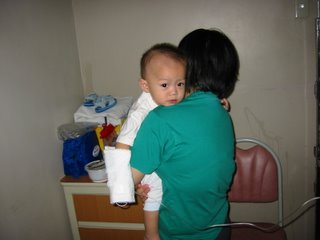
Me & Mommy

Duration: September 25 - September 30, 2006
Diagnosis: gastroenteritis

Me & Mommy

Saturday, September 16, 2006


Monday, September 11, 2006


Tuesday, September 05, 2006
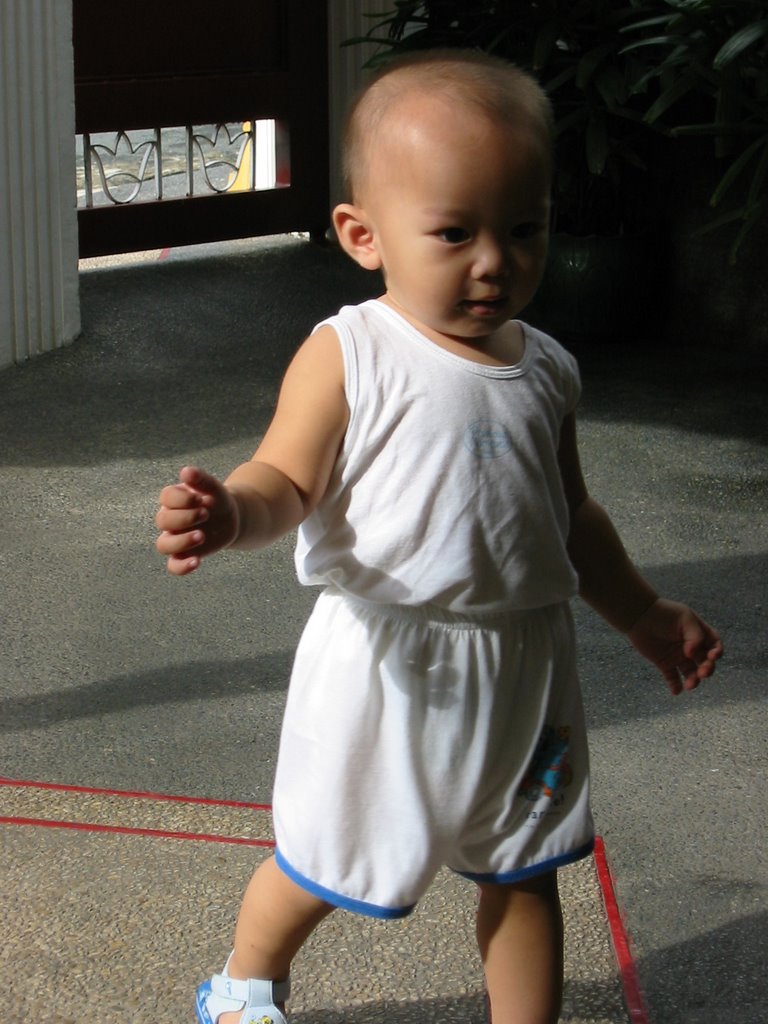
Here i go pussycat!
While waiting for daddy to come out... (you see, Duncan's been accompanying Daddy on his way to the office just outside the gate)...there he saw outside the gate a gold colored pussycat. He simply walked on his own to go "get" the pussy...! and those were more steps that mommy can count.
Saturday, September 02, 2006
HEPATITIS A VACCINE
Duncan's weight - 11.5 kgs
Duncan's height - 83 cms.
Administered in the right leg. Cried for approx 2 seconds.
Special Instruction :
Paracetamol Drops 1.2 ml every 4 hours for fever 37.8 and above.
Note: Duncan did not have a fever at all (9/03)
Duncan's height - 83 cms.
Administered in the right leg. Cried for approx 2 seconds.
Special Instruction :
Paracetamol Drops 1.2 ml every 4 hours for fever 37.8 and above.
Note: Duncan did not have a fever at all (9/03)
Friday, September 01, 2006
HEPATITIS A VACCINE (What you need to know)
Hepatitis A is a serious liver disease caused by the hepatitis A virus (HAV). HAV is found in the stool of persons with hepatitis A. It is usually spread byclose personal contact and sometimes by eating food or drinking water containing HAV.
Hepatitis A can cause:
•mild “flu-like”illness
•jaundice (yellow skin or eyes)
•severe stomach pains and diarrhea
People with hepatitis A often have to be hospitalized (up to about 1 person in 5). Sometimes, people die as a result of hepatitis A (about 3-5 deaths per 1,000 cases). A person who has hepatitis A can easily pass the disease to others within the same household. Hepatitis A vaccine can prevent hepatitis A.
Some people should be routinely vaccinated with hepatitis A vaccine:
• All children 1 year (12 through 23 months) of age.
• Persons 1 year of age and older traveling to or working in countries with high or intermediate
prevalence of hepatitis A, such as those located in Central or South America, Mexico, Asia (except Japan), Africa, and eastern Europe.
• Children and adolescents through 18 years of age who live in states or communities where
routine vaccination has been implemented because of high disease incidence.
• Men who have sex with men.
• Persons who use street drugs.
• Persons with chronic liver disease.
• Persons who are treated with clotting factor concentrates.
• Persons who work with HAV-infected primates or who work with HAV in research laboratories.
Other people might get hepatitis A vaccine in special situations:
• Hepatitis A vaccine might be recommended for children or adolescents in communities where
outbreaks of hepatitis A are occurring.
Hepatitis A vaccine is not licensed for children younger than 1 year of age.
For children, the first dose should be given at 12-23 months of age. Children who are not vaccinated by 2 years of age can be vaccinated at later visits. For travelers, the vaccine series should be started at least one month before traveling to provide the best protection.
For others, the hepatitis A vaccine series may be started whenever a person is at risk of infection.
Two doses of the vaccine are needed for lasting protection. These doses should be given at least 6 months apart. Hepatitis A vaccine may be given at the same time as other vaccines.
Hepatitis A can cause:
•mild “flu-like”illness
•jaundice (yellow skin or eyes)
•severe stomach pains and diarrhea
People with hepatitis A often have to be hospitalized (up to about 1 person in 5). Sometimes, people die as a result of hepatitis A (about 3-5 deaths per 1,000 cases). A person who has hepatitis A can easily pass the disease to others within the same household. Hepatitis A vaccine can prevent hepatitis A.
Some people should be routinely vaccinated with hepatitis A vaccine:
• All children 1 year (12 through 23 months) of age.
• Persons 1 year of age and older traveling to or working in countries with high or intermediate
prevalence of hepatitis A, such as those located in Central or South America, Mexico, Asia (except Japan), Africa, and eastern Europe.
• Children and adolescents through 18 years of age who live in states or communities where
routine vaccination has been implemented because of high disease incidence.
• Men who have sex with men.
• Persons who use street drugs.
• Persons with chronic liver disease.
• Persons who are treated with clotting factor concentrates.
• Persons who work with HAV-infected primates or who work with HAV in research laboratories.
Other people might get hepatitis A vaccine in special situations:
• Hepatitis A vaccine might be recommended for children or adolescents in communities where
outbreaks of hepatitis A are occurring.
Hepatitis A vaccine is not licensed for children younger than 1 year of age.
For children, the first dose should be given at 12-23 months of age. Children who are not vaccinated by 2 years of age can be vaccinated at later visits. For travelers, the vaccine series should be started at least one month before traveling to provide the best protection.
For others, the hepatitis A vaccine series may be started whenever a person is at risk of infection.
Two doses of the vaccine are needed for lasting protection. These doses should be given at least 6 months apart. Hepatitis A vaccine may be given at the same time as other vaccines.
Monday, August 28, 2006
Step 1 , Step 2!
Duncan starts walking!
It was early in the morning and then he just did it. He went to his Mama with rushing legs. Well, steps 1 - 4 is quite ok for the meantime.
Practice makes perfect. That night, he proudly showed his daddy that he can make step 1-2-3-4!
It was early in the morning and then he just did it. He went to his Mama with rushing legs. Well, steps 1 - 4 is quite ok for the meantime.
Practice makes perfect. That night, he proudly showed his daddy that he can make step 1-2-3-4!
Saturday, August 26, 2006


Monday, August 21, 2006
Guidelines on how to use a slide
Location: Sm Hypermarket - Ugong
Time : approx 2:30pm

Let your mommy help you to position on the top of the slide.

Help you some more...

Until you can balance yourself.

Hang-on for dear life.

And never easily let go.

Until you're ready.

To shout... yeeee haaaaaaaa!

And then you realized.... you did it!
Saturday, August 19, 2006
Juz Got Lucky!

While waiting for Daddy, Duncan and Mommy went to Quantum @ V-mall. Enjoyed the rides here and there until we got to the Ocean Park Game. On the start of the game you will push the lighted button that will drop a ball into a hole. Each hole as a number of tickets to be won where you can change at the counter for a corresponding price. For a starter... D's got lucky. One token, for his pushing the button gives us 50 tickets = a coloring pencil.
Not bad Duncan! Till we get the Jackpot!
Sunday, August 06, 2006


Saturday, August 05, 2006


CHICKENPOX VACCINE!
Special Instruction:
Paracetamol drops 1.2ml every 4 hours for temperature 37.8and above
Paracetamol drops 1.2ml every 4 hours for temperature 37.8and above
Tuesday, August 01, 2006
Chickenpox Vaccine - What you need to know.
Why get vaccinated?
Chickenpox (also called varicella) is a common childhood disease. It is usually mild, but it can be
serious, especially in young infants and adults.
• The chickenpox virus can be spread from person to person through the air, or by contact with fluid from chickenpox blisters.
• It causes a rash, itching, fever, and tiredness.
• It can lead to severe skin infection, scars, pneumonia, brain damage, or death.
• A person who has had chickenpox can get a painful rash called shingles years later.
Chickenpox vaccine can prevent chickenpox.
Most people who get chickenpox vaccine will not get chickenpox. But if someone who has been
vaccinated does get chickenpox, it is usually very mild. They will have fewer spots, are less likely to have a fever, and will recover faster.
Who should get chickenpox vaccine and when?
Children should get 1 dose of chickenpox vaccine between 12 and 18 months of age,
or at any age after that if they have never had chickenpox.
• People should not get chickenpox vaccine if they have ever had a life-threatening allergic reaction to gelatin, the antibiotic neomycin, or (for those needing a second dose) a previous dose of chickenpox vaccine.
• People who are moderately or severely ill at the time the shot is scheduled should usually wait until they recover before getting chickenpox vaccine.
• Pregnant women should wait to get chickenpox vaccine until after they have given birth. Women should not get pregnant for 1 month after getting chickenpox vaccine.
• Some people should check with their doctor about whether they should get chickenpox vaccine,
including anyone who:
- Has HIV/AIDS or another disease that affects the immune system
- Is being treated with drugs that affect the immune system, such as steroids, for 2 weeks or
longer
- Has any kind of cancer
- Is taking cancer treatment with x-rays or drugs
• People who recently had a transfusion or were given other blood products should ask their
doctor when they may get chickenpox vaccine.
People who do not get the vaccine until 13 years of age or older should get 2 doses, 4-8 weeks
apart.
Chickenpox vaccine may be given at the same time as other vaccines.
What are the risks from chickenpox vaccine?
A vaccine, like any medicine, is capable of causing serious problems, such as severe allergic reactions. The risk of chickenpox vaccine causing serious harm, or death, is extremely small.
Getting chickenpox vaccine is much safer than getting chickenpox disease. Most people who get chickenpox vaccine do not have any problems with it.
Mild Problems
• Soreness or swelling where the shot was given (about 1 out of 5 children and up to 1 out of 3
adolescents and adults)
• Fever (1 person out of 10, or less)
• Mild rash, up to a month after vaccination (1 person out of 20, or less). It is possible for these
people to infect other members of their household, but this is extremely rare.
Moderate Problems
• Seizure (jerking or staring) caused by fever (less than 1 person out of 1,000).
Severe Problems
• Pneumonia (very rare)
Other serious problems, including severe brain reactions and low blood count, have been reported after chickenpox vaccination. These happen so rarely experts cannot tell whether they are caused by the vaccine or not. If they are, it is extremely rare.
Chickenpox (also called varicella) is a common childhood disease. It is usually mild, but it can be
serious, especially in young infants and adults.
• The chickenpox virus can be spread from person to person through the air, or by contact with fluid from chickenpox blisters.
• It causes a rash, itching, fever, and tiredness.
• It can lead to severe skin infection, scars, pneumonia, brain damage, or death.
• A person who has had chickenpox can get a painful rash called shingles years later.
Chickenpox vaccine can prevent chickenpox.
Most people who get chickenpox vaccine will not get chickenpox. But if someone who has been
vaccinated does get chickenpox, it is usually very mild. They will have fewer spots, are less likely to have a fever, and will recover faster.
Who should get chickenpox vaccine and when?
Children should get 1 dose of chickenpox vaccine between 12 and 18 months of age,
or at any age after that if they have never had chickenpox.
• People should not get chickenpox vaccine if they have ever had a life-threatening allergic reaction to gelatin, the antibiotic neomycin, or (for those needing a second dose) a previous dose of chickenpox vaccine.
• People who are moderately or severely ill at the time the shot is scheduled should usually wait until they recover before getting chickenpox vaccine.
• Pregnant women should wait to get chickenpox vaccine until after they have given birth. Women should not get pregnant for 1 month after getting chickenpox vaccine.
• Some people should check with their doctor about whether they should get chickenpox vaccine,
including anyone who:
- Has HIV/AIDS or another disease that affects the immune system
- Is being treated with drugs that affect the immune system, such as steroids, for 2 weeks or
longer
- Has any kind of cancer
- Is taking cancer treatment with x-rays or drugs
• People who recently had a transfusion or were given other blood products should ask their
doctor when they may get chickenpox vaccine.
People who do not get the vaccine until 13 years of age or older should get 2 doses, 4-8 weeks
apart.
Chickenpox vaccine may be given at the same time as other vaccines.
What are the risks from chickenpox vaccine?
A vaccine, like any medicine, is capable of causing serious problems, such as severe allergic reactions. The risk of chickenpox vaccine causing serious harm, or death, is extremely small.
Getting chickenpox vaccine is much safer than getting chickenpox disease. Most people who get chickenpox vaccine do not have any problems with it.
Mild Problems
• Soreness or swelling where the shot was given (about 1 out of 5 children and up to 1 out of 3
adolescents and adults)
• Fever (1 person out of 10, or less)
• Mild rash, up to a month after vaccination (1 person out of 20, or less). It is possible for these
people to infect other members of their household, but this is extremely rare.
Moderate Problems
• Seizure (jerking or staring) caused by fever (less than 1 person out of 1,000).
Severe Problems
• Pneumonia (very rare)
Other serious problems, including severe brain reactions and low blood count, have been reported after chickenpox vaccination. These happen so rarely experts cannot tell whether they are caused by the vaccine or not. If they are, it is extremely rare.
Sunday, July 30, 2006
Gifts!
 My Gift List:
- Megabloks ABC Train
- Locomotive Train
- Educational activity book with cd
- Tarpauline
- Hotdog Pillow
- Justice League shirt
- Shape Sorting Farm
- Brainy Baby 123's Tab Book
- Photo Bubble Head
- Steering Wheel
- Doodles stuff toy (blue)
- Car Seat Pillow
- PLAYSKOOL BUSY GLOW Flashlight
- PLAYSKOOL RUMBLIN' Rollers Rumplin' Dump Truck
- Brainy Baby Alphabet Slide and Learn
- Sesame St. Educational Puzzle
- Activity Center
- My First Bible
- Artist's Set
- Megabloks Lil' Dump Truck
- Greeting Card
- Tomy Clip Clop Cowboy
- Disney's Rail Road Train
- Park n Sort Garage
- Puzzle Ball
- Stuff Toy (Dog)
- Stuffed Toy Pillow (Cow)
- Superman Action Figure
- Superman Swingshot Figure
- Photo Frame and Album
- Blue Car
- Ampao
- Garfield Polo and Pants
- Sando w/ shorts (5x)
- Carter's 3 pc set
- Tommy Red Shirt w/ matched shorts
- Garfield t-shirt & shorts (3x)
- Brat t-shirt /matched shorts
- Mossimo Red Shirt
- Enfant Socks (3x)
- Pair of shirt & short (3x)
- Disney Pants
- Starbaby Sando & Shorts
- Grizzly Polo Shirt
- Musical Rocking Horse
- Pair of Pajamas
- OshKosh Shorts
- OshKosh T-shirt
- Towels (4x)
Many thanks.......!
Subscribe to:
Posts (Atom)